Inside the high-stakes arena of modern professional sliding, success is not merely purely a function of brute torque or driver courage. Conversely, it has become a intricate engineering challenge that requires a scrupulous fusion of choosing a time-tested chassis, equipping it with the most precise competition components, and, most importantly, grasping its dynamic behavior on the course through advanced drift telemetry software. This definitive guide functions as your roadmap from the very first idea of a project car all the way to the last telemetry-optimized refinements that turn a capable car into a repeatable winner. We will examine in detail the art and science of car suspension tuning, illustrating how a state-of-the-art drift tuning app like precise measurement hardware eliminates guesswork and provides unparalleled insight into your vehicle's true performance.
The foundation of any great drift car is, without question, the chassis itself. Certain platforms have achieved legendary status within the international oversteer scene due to their natural balance, robust construction, and the vast availability of specialist components available. Choosing the correct car is the first and most crucial selection a driver will make. To illustrate, the BMW's E36 3 Series is universally acknowledged as among the best all-around cars for drifting of the modern era. Its almost ideal balanced front-to-rear weight, coupled with a rear-wheel-drive setup and extremely reliable straight-six powerplants, forms a car that is at once easy to handle for newcomers and incredibly effective in the possession of a expert competitor. The next step of this philosophy, the BMW E46 platform, refines these qualities with a even more developed structure, broader wheel track for improved high-speed stability, and still more steering angle straight from the OEM. A different powerful option in the pro scene is the Corvette C6.
This American track weapon brings a particular set of benefits to the sliding world, featuring a light aluminum frame, a rear-mounted drivetrain component that helps create an perfect front-to-rear mass ratio, and the immense torque of a powerful GM LS engine. This fusion makes it an absolute weapon on track, designed of initiating and holding extended slides with relatively easy application of power. For those desiring outstanding bang-for-the-buck, the Nissan Z33 rises above as a prime example. It arrives from the factory with a stiff body structure, a competent OEM locking differential, and the free-revving V6 powerplant that delivers sufficient horsepower and torque for learning and moving up in the discipline. Its newer version, the 370Z model, offers additional improvements in body strength, suspension design, and overall powerplant output, cementing its place as a popular choice among competitive pilots. Additional legendary vehicles that deserve attention include the lightweight Wankel-engined Mazda FC, the most popular Nissan S13 240SX, the American SN95 generation Mustang, the electronic-equipped BMW E90, and the tiny yet incredibly engaging and teachable MX-5 Miata. Each of these platforms gives a distinct array of attributes, difficulties, and possibilities, but they all have in common the basic components necessary to become a serious drift machine.
However, choosing the right car is just the beginning. To access the true capability of every of these machines, significant changes to the steering and suspension systems are absolutely non-negotiable. This is where the world of performance aftermarket parts becomes vital focus. The most most transformative modification for a dedicated competition vehicle is the fitting of a maximum-angle angle modification kit. These engineered assemblies, for example those developed by specialist companies like SLR, are engineered to significantly increase the car's possible steering angle. A factory street car is extremely restricted in how far its tires can turn, a engineering limitation for public road operation. In oversteer driving, but, aggressive opposite lock is constantly necessary to catch and hold a slide. An modification kit replaces the stock uprights, linkages, and often A-arms with parts that permit the front tires to attain angles over 70 or even 80 degrees, as opposed to a typical stock setting of around 40 to 50 °.
This tremendously greater lock provides the operator with dramatically more control during a angle, allowing it to be far more straightforward to start a slide, hold it through a extended corner, and change seamlessly from one direction to the opposite. The contrast in drivability is truly transformative. Paired with a correctly selected angle kit is the every bit as vital enhancement to the car's damping system. Store-bought or even high-end street dampers are generally not intended for the specific and harsh requirements of sliding. A dedicated set of coilovers is paramount. These engineered coilovers feature custom piston tuning and spring stiffness that are tuned for the violent weight transfer that is typical of sliding. When a operator initiates a slide, the chassis's mass is transferred violently to the outside of the bend. Proper competition suspension manage this movement in a controllable fashion, allowing the car to find its balance quickly and providing the pilot accurate feedback through the wheel and cockpit. They also enable accurate tuning of ground clearance, shock absorber stiffness, and cross-weight, which are all key elements of fine-tuning the vehicle's behavior to a given venue or driving style. Together, a precision-engineered angle modification system and a expertly specified set of drift-spec adjustable dampers constitute the undeniable hardware cornerstone upon which all later refinement is built.
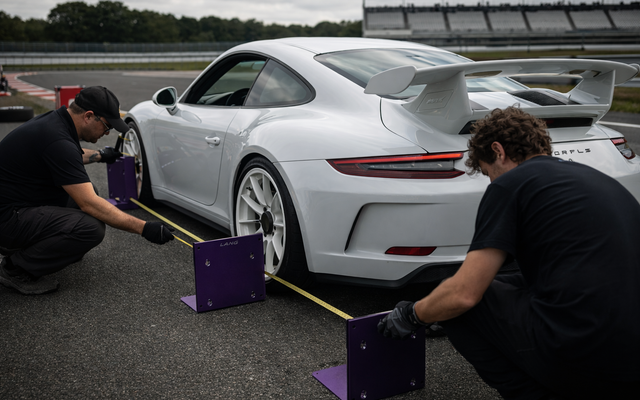
Once the essential hardware is in place, the following critical step in the project is the precise setting of the chassis's suspension geometry. This is the world of vehicle alignment optimization, a methodology that can seem intimidating to the beginner but is, in practice, the key to converting a set of fast parts into a cohesive and consistent vehicle. The most critical aspect of suspension geometry for sliding is definitely camber. Camber is the tilt of the tire compared to the perfectly straight axis when viewed from the front-on of the car. If the top edge of the tire is angled inward, this is called camber-in. For sliding, inward-leaning wheels on the steering tires is widely used and is regarded as necessary. The logic is intrinsically tied to tire contact.
When a chassis is going around a bend at limit sideways angles, the frame tilts to the external of the bend. This lean forces the outer steering tire to reduce its ideal footprint with the track surface. By adding an inward tilt, the tire is pre-tilted to compensate for this roll. As the car leans into the corner, the outside front tire gains a better contact patch with the asphalt, increasing its traction at the exact moment when it is needed most for directional command. Commonly, front axle angles for a dedicated drift car fall between approximately -3 degrees to as high as -5 degrees or even greater, based on the specifics of the vehicle geometry, rubber choice, and operator feel. The rear axle wheels also employ negative camber, but the values are typically less and less aggressive than the front axle. Excessive camber at the back can cause the vehicle to overly prone to oversteer and challenging to control on acceleration use, as it shrinks the available contact patch of the driven wheels during straight-line throttle application. Thus, rear axle angles are often in the ballpark of -1 degree to -3 degrees, striking a precise balance between giving sufficient cornering traction to assist in entering and maintaining the angle while still preserving usable hook-up for acceleration the corner. Camber is merely one component of the broader alignment puzzle, which furthermore encompasses toe, caster, and suspension-induced steering adjustment.
Toe refers to the orientation of the wheels when viewed from a bird's-eye view. Inward toe means the leading edges of the wheels are nearer together than the trailing edges, while toe-out means the converse. For sliding, a small amount of front axle negative toe is commonly run to improve the initial response handling reaction, making the vehicle feel more nimble and eager to initiate a slide. Rear axle toe angle is generally set to zero or a extremely slight amount of toe-in to foster straight-line stability under throttle. caster angle is the longitudinal or backwards angle of the steering axis when observed from the lateral of the chassis. Positive caster improves feedback and high-velocity solidity, and it furthermore adds to camber gain during cornering, which is highly beneficial. Adjusting these parameters is a complex interplay where a change to one setting can and will affect the others. The old-school approach for tuning a vehicle's alignment for drifting has historically been a time-consuming affair of trial and error. A pilot or crew would introduce a change based on intuition, test the chassis on track, rely on the driver's personal sensation and impressions, and then introduce another change. This loop would continue time after time until the car felt "good" or the available practice period ended. This methodology is not only incredibly inefficient in terms of man-hours and resources, but it is furthermore fundamentally inaccurate.
Human perception is a famously unreliable metric, influenced by numerous elements such as fatigue, varying track grip levels, temperature, and just the focus of the driver on that specific run. What feels "loose" on one pass might drift suspension tuning guide feel "understeery" on the next lap, resulting in contradictory data and ineffective changes. This age-old problem in vehicle dynamics optimization is exactly where state-of-the-art engineering tools has stepped in to transform the process.
The development and adoption of sophisticated drift telemetry software has ushered in a new age for building and perfecting competitive sliding vehicles. These systems, represented by cutting-edge systems like GripDial, function by physically capturing the real-time dynamic movement of the chassis as it is being driven on the track. Unlike using personal feel, these devices gather objective data on essential parameters such as damper compression and extension, corner velocities, acceleration forces, steering angle, and throttle and brake position. This raw information flow is then analyzed by advanced software that can plot and analyze the information in a comprehensible way. For the very first time, drivers and teams can observe exactly what the car is performing at each moment of a drift. This function revolutionizes the complete suspension tuning workflow. Consider the particular goal of setting the front axle negative camber for a particular car. Instead of introducing a change from -3 degrees to -3.5 degrees and then testing several runs to try and "feel" a improvement, a suspension tuning tool can provide immediate and definitive data. The software can indicate visually how the suspension's grip is behaving during the key stages of a angle: initiation, mid-corner, and changing direction. It can show if the present camber setting is allowing the outside front tire to keep optimal grip or if the rubber is overloaded on its outside shoulder.
The system can then make data-driven suggestions for adjustment. Perhaps the data indicates that the outside front tire is even overloading its edge at -3.5 degrees of negative camber, implying that even more angle, say -4 degrees, might be advantageous. On the other hand, the information might indicate that the tread is not reaching optimal operating temp or that the inner shoulder is wearing unevenly, which could suggest that there is excessive negative camber and a small reduction back to -3.2 degrees would be more ideal. This standard of granularity and actionable insight was completely unimaginable in the era of pure mechanical tuning.
The benefit of utilizing a dedicated drift telemetry system goes far beyond just optimizing camber angles. It functions as an priceless suspension tuning guide that is specific to your particular car. When adjusting the rebound and compression values on your suspension, instead of using imprecise tips or mimicking another car's settings, you can employ the software to see how the car is performing in reaction to your adjustments. The application can show the wheel movement trace over a lap, revealing if the dampers are handling the weight transfer effectively or if they are permitting the chassis to bounce excessively after a flick. drift angle kits It can help in pinpointing challenges drift angle kits like hitting the bump stops or losing droop, allowing you to make informed decisions to spring preload, rebound/compression values, or ground clearance. This process extends just as well to the detailed process of suspension geometry optimization. In addition to camber angle, the tool can give insight into how adjustments to toe and caster angle are affecting the car's stability during various maneuvers of a drift. For instance, it can allow you to determine the best amount of front negative toe for your particular steering rack setup and piloting style by showing the response time of initial reaction and the predictability of the chassis at full steering angle. This turns the tool an incredibly useful vehicle dynamics manual that is constantly calibrated by the live dynamics of your specific vehicle on the circuit. It moves the whole project from a dark art into a scientific optimization process.
Moreover, the application of a system like modern telemetry is in no way limited to expert tuners with extensive funding. For the grassroots driver, it acts as an powerful force multiplier. It effectively offers the builder with the analysis of a full-time suspension specialist without the corresponding cost. It accelerates the learning curve by providing definitive answers to questions that would normally take countless track days of experience to understand. A tuner can see how their specific vehicle behaves to various adjustments, developing a more profound knowledge of suspension theory in the endeavor. It also opens up high-level suspension engineering concepts, permitting anyone with the desire to perfect their car to do so in a structured and effective fashion. This is particularly important in a activity like sliding, where tuning knowledge has historically been a closely guarded commodity among top crews. Today, that capability can be in the garage of every motivated driver.
In conclusion, the process to constructing and tuning the perfect championship-contending sliding vehicle is a comprehensive endeavor that seamlessly combines classic engineering wisdom with revolutionary digital technology. It starts with the wise choice of a legendary car, then enhanced by the integration of critical performance hardware like maximum-angle drift angle kits and properly selected competition suspension units. The process then moves into the detailed realm of chassis dynamics adjustment, where values like negative camber, toe setting, and caster angle are carefully set to match the chassis's modified capabilities and the operator's personal needs. Ultimately, and what truly separates the modern process from the old ways, is the integration of a powerful suspension tuning application. This system eradicates the uncertainty and inefficiency of only subjective adjustment by delivering objective, live information on how the vehicle is truly functioning. It acts as an unparalleled suspension tuning tool, a definitive drift suspension tuning guide, and a comprehensive chassis development system. Together, this integrated philosophy ensures that every element of the competition vehicle—from the selection of the platform to the last tweak on the damper—is optimized for peak success on the competition venue. It represents the complete maturation of the art of oversteer driving, bridging physical pilot talent with data-informed vehicle setup to create the ultimate dominant vehicles attainable.